
Why Roof Ventilation Matters
A roof space has to breathe. When it can't, the moisture from an ordinary household condenses on the coldest surfaces in the house, which are the roof timbers and the underside of the covering.
The Condensation Problem
Every household puts litres of water vapour into the air each day from cooking, showers, laundry and breathing. Warm air carrying it rises through the ceiling into the loft. If the loft is well insulated and badly ventilated, the air cools fast and the vapour condenses on the felt, the rafters and the back of the slates, sometimes dripping back down onto the insulation. On Sale houses that have had the eaves blocked with insulation or sealed with solid soffits, this happens every winter.
Consequences of Poor Ventilation
Damp insulation that stops working. Mould on the rafters and on the stored boxes. Rot in the battens and rafter feet. Mould on ceilings and in the corners of upstairs rooms. Water staining that gets mistaken for a leak and leads to expensive, pointless roof repairs. In the worst cases across Sale, M33 we've seen roof timbers that needed replacing purely because the loft couldn't dry out.
Ventilation and insulation go together: adding one without the other is the commonest cause of loft condensation in Sale. Low-level air usually comes in through vented soffits, and high-level vents are easiest to add during a new roof.
Ventilation Solutions
Four types of vent cover nearly every roof in Sale, usually in combination so that air can get in low and out high.
Soffit Vents
Continuous vent strips or circular vents in the soffit boards under the eaves, with ventilation trays between the rafters so the insulation can't block them. The standard way to get air into a cold roof, and included whenever we fit new soffits.
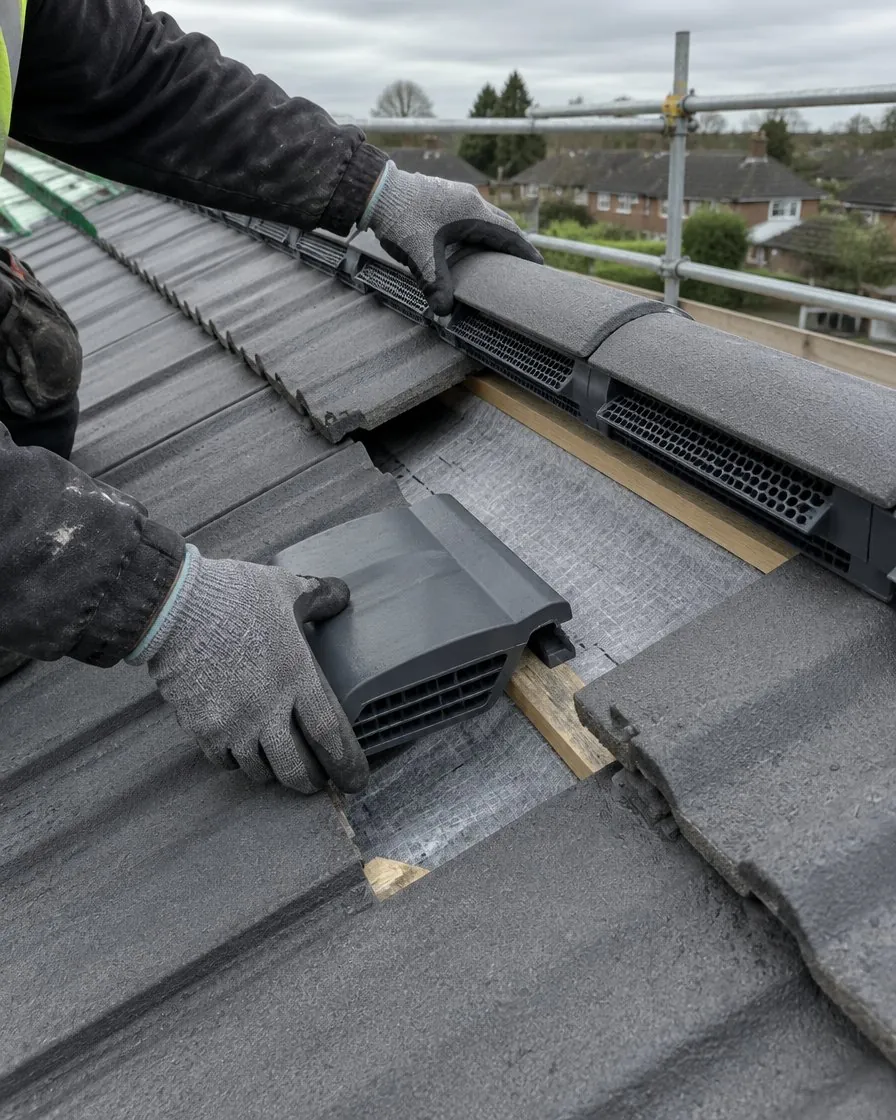
Tile Vents
Vents made to match the roof tile or slate, fitted into the slope to let air out high up or to vent an extractor fan or soil pipe through the roof. Useful on hipped roofs with short ridges.
Ridge Vents
A ventilated dry ridge system lets air out along the whole length of the ridge, which combined with soffit vents gives the cross-flow a loft needs. We fit it as standard on every re-roof.
Over-Fascia Vents
A ventilated strip fixed over the fascia under the first course of tiles, for roofs with no soffit or where the soffit can't be vented. Common on the terraced houses of Sale with flush eaves.
Building Regulations
Ventilation isn't optional on new and renewed roofs; the regulations set minimum areas of opening at the eaves and ridge depending on the pitch and the type of roof.
General Requirements
A cold pitched roof needs continuous ventilation at the eaves equivalent to a 10 mm gap along both sides, plus ridge ventilation equivalent to a 5 mm gap on low pitches and on roofs with a vapour-resistant underlay. Warm roofs and rooms-in-the-roof need a ventilated void above the insulation. We design to these on every roof we touch in Sale, M33, and building control checks them on a re-roof.
Signs You Need Better Ventilation
Water droplets or frost on the underside of the felt in winter. Dark staining or mould on the rafters. Damp, flattened insulation. A musty smell in the loft. Mould in the corners of upstairs ceilings. Stored boxes that come out of the loft damp. Condensation on the inside of roof windows. Any of these on a Sale house points to a loft that can't breathe, and the fix is almost always ventilation rather than a roof repair.
Combining Ventilation With Other Work
Ventilation is cheapest when it's part of something else. New soffits get vented as standard. A re-roof gets a ventilated ridge and eaves trays. Loft insulation top-ups get ventilation trays fitted at the same time so the new insulation doesn't block the eaves. A roof window installation gets the surrounding ventilation checked. If we're already on your Sale roof for any of these, adding the ventilation it needs is a small extra; on its own it's still a quick, inexpensive job.
Ventilation for Loft Conversions and Rooms in the Roof
When a loft becomes a room, the ventilation that used to happen across the open loft space has to be redesigned. Insulation now follows the slope of the roof, so each rafter void needs its own path for air from eaves to ridge, or a breathable membrane and a design that manages moisture without a ventilated gap. Getting this wrong is one of the most common causes of mould in loft rooms in Sale, often appearing a winter or two after the conversion is finished.
We look at the whole build-up when we're asked about a damp loft room: insulation type, vapour control on the warm side, membrane, and any vents already in place. The fix is sometimes as simple as adding ridge or tile vents; sometimes it means opening up part of the roof to correct how the insulation was installed.
Ventilation and Flat Roofs
Flat roofs are particularly vulnerable to condensation. A cold flat roof with insulation between the joists needs a clear, ventilated gap above the insulation with vents on opposite sides, which many older roofs in Sale, M33 simply don't have. The result is a deck that rots from underneath while the covering still looks fine. When we replace these roofs we usually convert them to warm roofs, which don't need ventilating because the deck stays above the dew point. See our flat roofing page for more.
Bathrooms, Kitchens and Extractor Fans
A surprising amount of loft moisture comes from extractor fans that vent into the roof space rather than outside. We regularly find bathroom fan ducts in Sale lofts that end in the insulation, or that have come loose over the years. Every time someone showers, warm wet air goes straight into the loft. We extend ducts to a proper tile vent or soffit outlet so the moisture leaves the building, which is often the single most effective fix for a damp loft.